The US sent Europe another warning signal.
In late July 2026, the United States made an unexpected move. It sold part of its euro reserves on the foreign exchange market to prop up a weakened Japanese yen. The move itself wasn’t surprising. Interventions to support an ally’s currency are nothing new. The way it was carried out was.
The European Central Bank found out about it only after the fact. Interventions like this have typically been coordinated with partners, at least in broad strokes, beforehand. Not this time.
Why Washington did it
From a US perspective, the logic holds. Japan is the largest creditor of the United States, holding more US government debt than any other country. If Washington hadn’t stepped in to support the weakened yen, Tokyo would likely have had to sell US treasuries to fund its own intervention, and for the US, that would have meant significantly higher interest costs on its national debt.
So the move makes economic sense. The way it was executed (without consultation, without warning) is what should give you pause.
A pattern that keeps repeating
The common thread between this FX intervention and the trade restrictions of recent months is the same pattern. Washington acts unilaterally and informs partners after the fact, if at all. For the currency markets, that’s an unpleasant surprise. For your company, that same pattern can be a direct operational risk, through a completely different channel, your data.
What the US CLOUD Act is
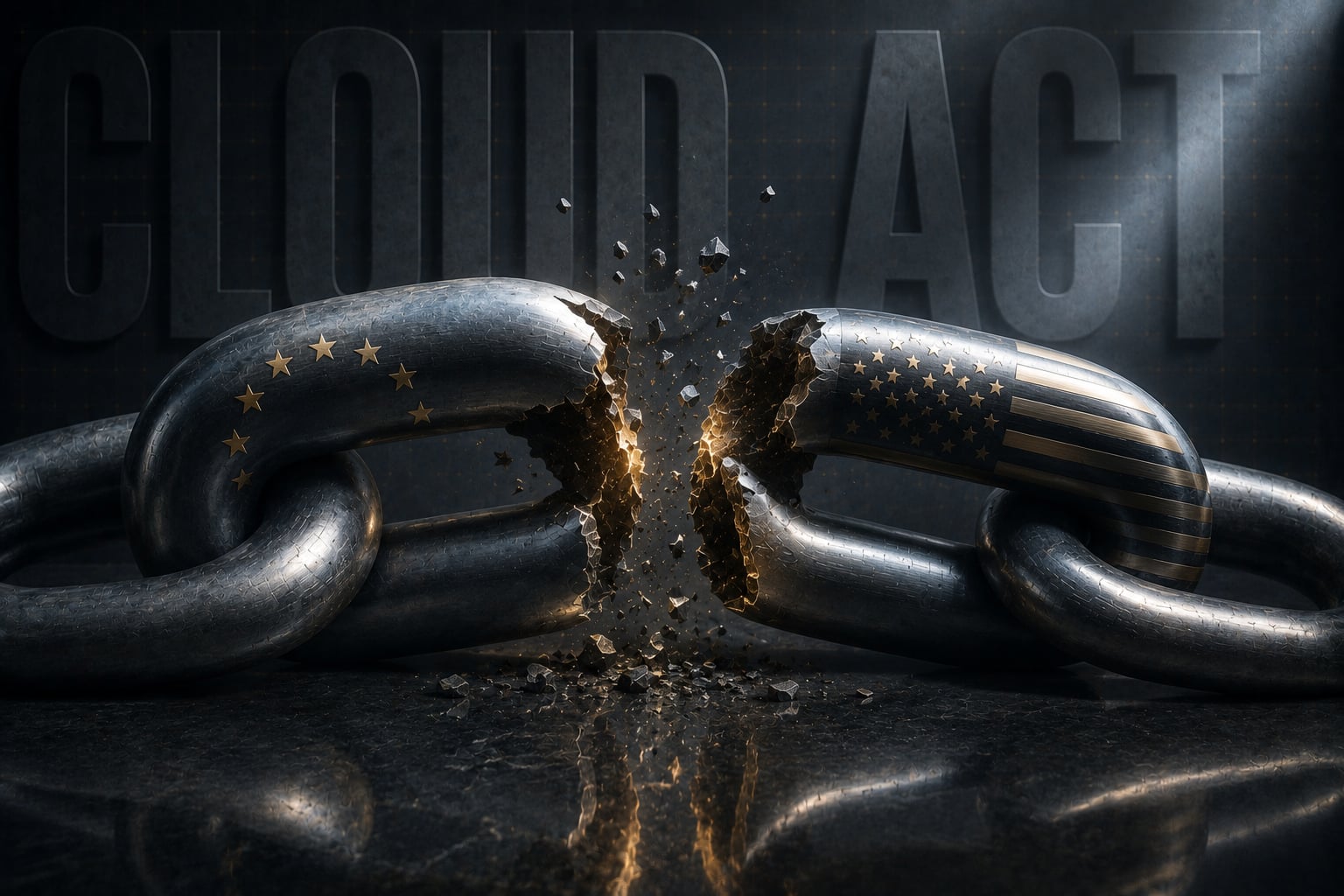
The CLOUD Act (Clarifying Lawful Overseas Use of Data Act) is a US law passed in 2018. It gives Washington the right to compel US companies to hand over data they manage, regardless of where in the world the servers physically sit.
In practice, that means a US-headquartered provider hosting data on servers in Germany or Ireland can be legally compelled to hand that data over to US authorities. The physical location of the server doesn’t matter. What matters is the legal jurisdiction the company itself falls under.
For companies used to thinking about data sovereignty in terms of “where the server sits,” that’s an uncomfortable realization. The server can sit in Frankfurt. The decision about who gets access to it can be made in Washington.
The risk you carry every day
This risk isn’t limited to large institutions or the currency markets. It flows directly into the daily operations of any company running on American software:
- CRM and project-management systems
- Cloud infrastructure
- AI tools and business-critical data
If another unexpected move comes (a sanction, a trade restriction, or simply a policy shift), losing or restricting access to these systems could disrupt your company overnight.
A short audit for your company
- Pick the 5 tools your business depends on most.
- Find out which legal jurisdiction their vendor falls under.
- Check whether a European alternative you know of exists.
- Think through what happens if access to it is cut off overnight.
- If even one of those tools falls under US jurisdiction, you’re already carrying this risk.
The fix is reducing dependency
The fix isn’t panic, and it isn’t replacing everything at once. The fix is deliberately reducing dependency on American services where it makes sense, so the next unexpected decision doesn’t catch you off guard.
At Vyxos, this is exactly why we build 100% European software. We combine uncompromising data security, high stability, and top-tier UX. For companies that no longer want their operations put at risk by a decision they have no control over.