AI content on the web has new rules from August

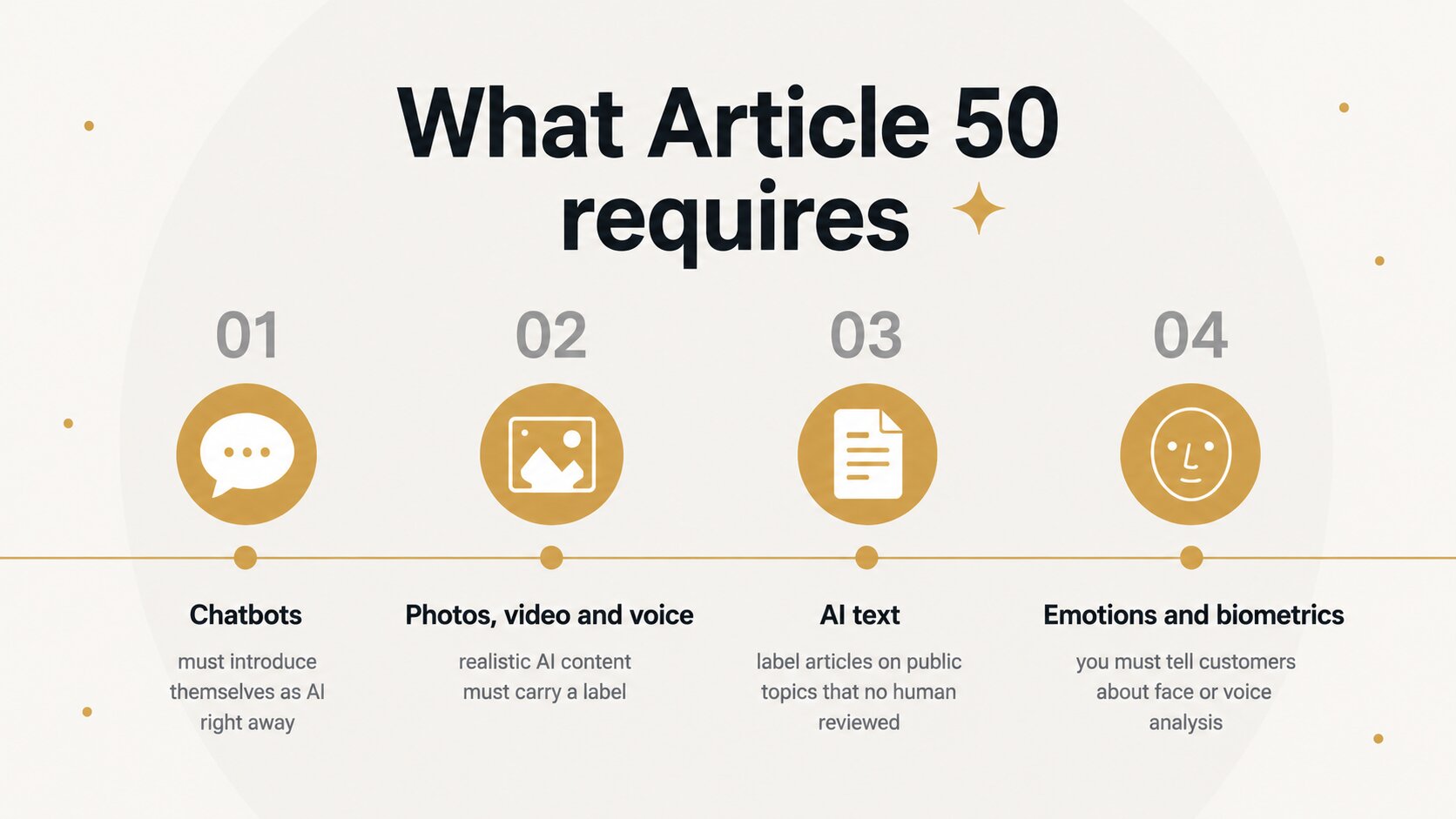
On 2 August 2026, Article 50 of the European AI Act (Regulation EU 2024/1689) took effect. It introduces a transparency obligation. Customers must know when they are talking to artificial intelligence and when they are looking at content that AI created or substantially edited.
Fines reach up to 15 million euros or 3 percent of worldwide turnover. The upper limit is written for the big players, but the obligation applies to every website where a customer encounters AI content or a chatbot. That includes an ordinary company.
Does this apply to you?
What matters is what you actually do with AI and what your customers see. Most companies fall into one of these three situations:
-
You run an AI chatbot or publish realistic AI content
This applies to you in full. The chatbot has to introduce itself as AI at first contact, and realistic photos, videos or voice recordings need a visible label.
-
You only write texts with AI
There is nothing to label. The obligation does not apply to product descriptions, categories, newsletters or ad copy.
-
Articles on public topics, emotion or biometric analysis
AI-written articles on public topics are mostly a matter for media and news sites. Emotion and biometric analysis is used by specific applications. If you use them, you must clearly inform users in advance that AI processes their voice or face.
The rules in practice
A chatbot introduces itself as AI
If your site has an AI chatbot, a voice assistant or automated customer support, the user must be informed that they are communicating with AI, right at first contact. The only exception is when it is obvious even without a notice.
In practice, a sentence in the welcome message or the chat’s name is enough: “I’m an AI assistant and I’ll help you choose a product.”
Realistic images, video and voice
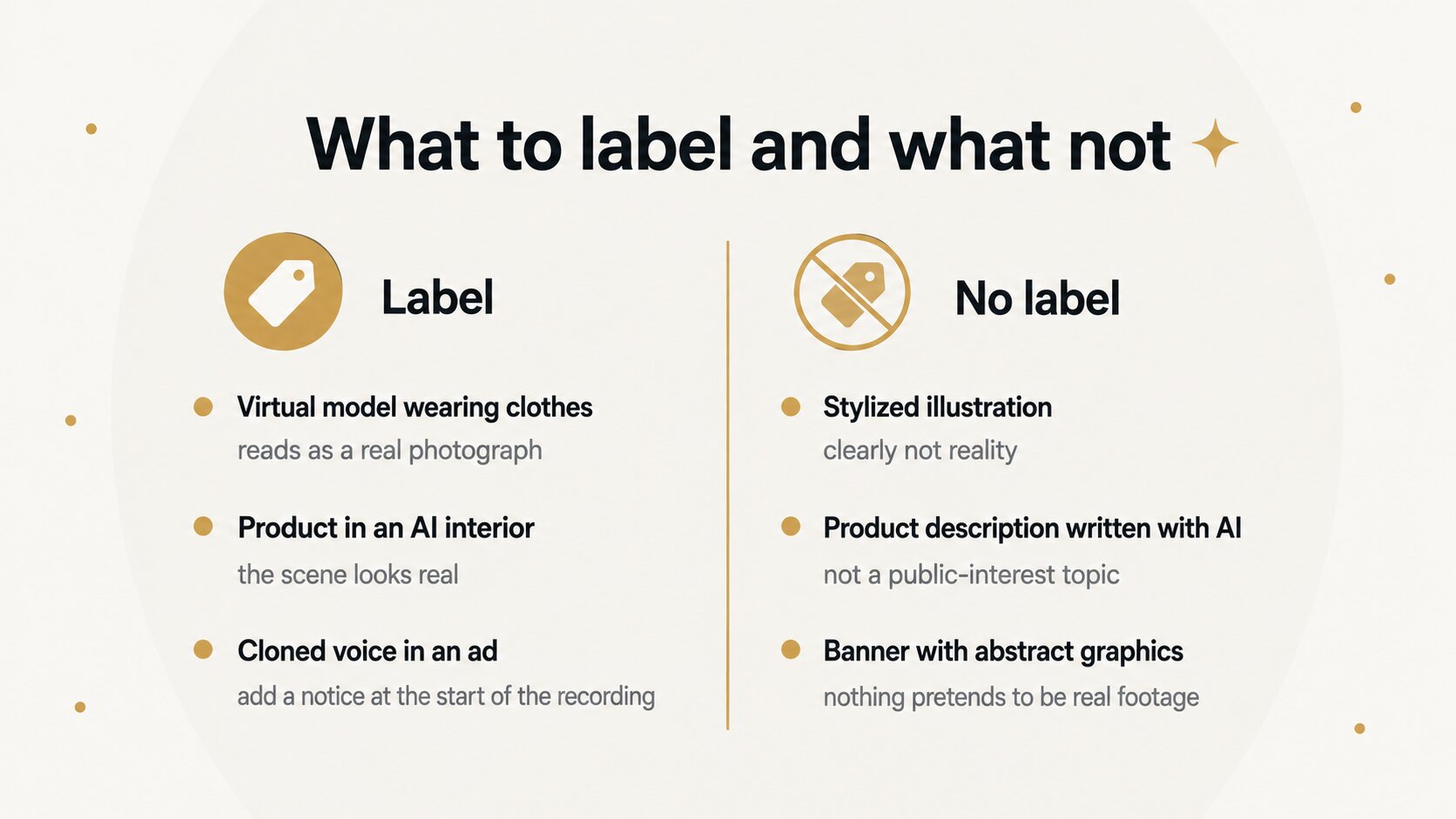
The labeling obligation covers so-called deepfake content, meaning images, audio or video that looks like a genuine record of a person, product, place or event, but was in fact created or substantially edited by AI. In practice that can be a virtual model presenting clothing, a product placed into a realistic AI scene, a cloned voice in an ad, or a video that looks like real footage.
The label must be clearly attached to the specific content. On an image the tag belongs in the corner or right next to it, on video it should ideally stay visible during playback, and in audio a notice plays at the start of the recording. Wording like “Image generated with AI” or “The voice in this recording was generated with AI” is sufficient. The Commission also offers uniform icons.
Exceptions: art, satire, AI text and biometrics
For clearly artistic or satirical works the regime is softer. A discreet disclosure that does not spoil the experience of the work is enough.
AI text has its own rule. Product descriptions, categories, newsletters and ad copy written with AI need no label. The obligation only covers text published to inform the public on matters of public interest (politics, health, safety, the economy). And even there it falls away if the text went through human editorial review and someone carries editorial responsibility for it. It concerns media and blogs on societal topics rather than ordinary company websites.
And if you were to use systems for emotion recognition or biometric categorisation of customers, such as analysing facial expressions in a store, you must inform the people concerned.
Key dates, the delay and the fines
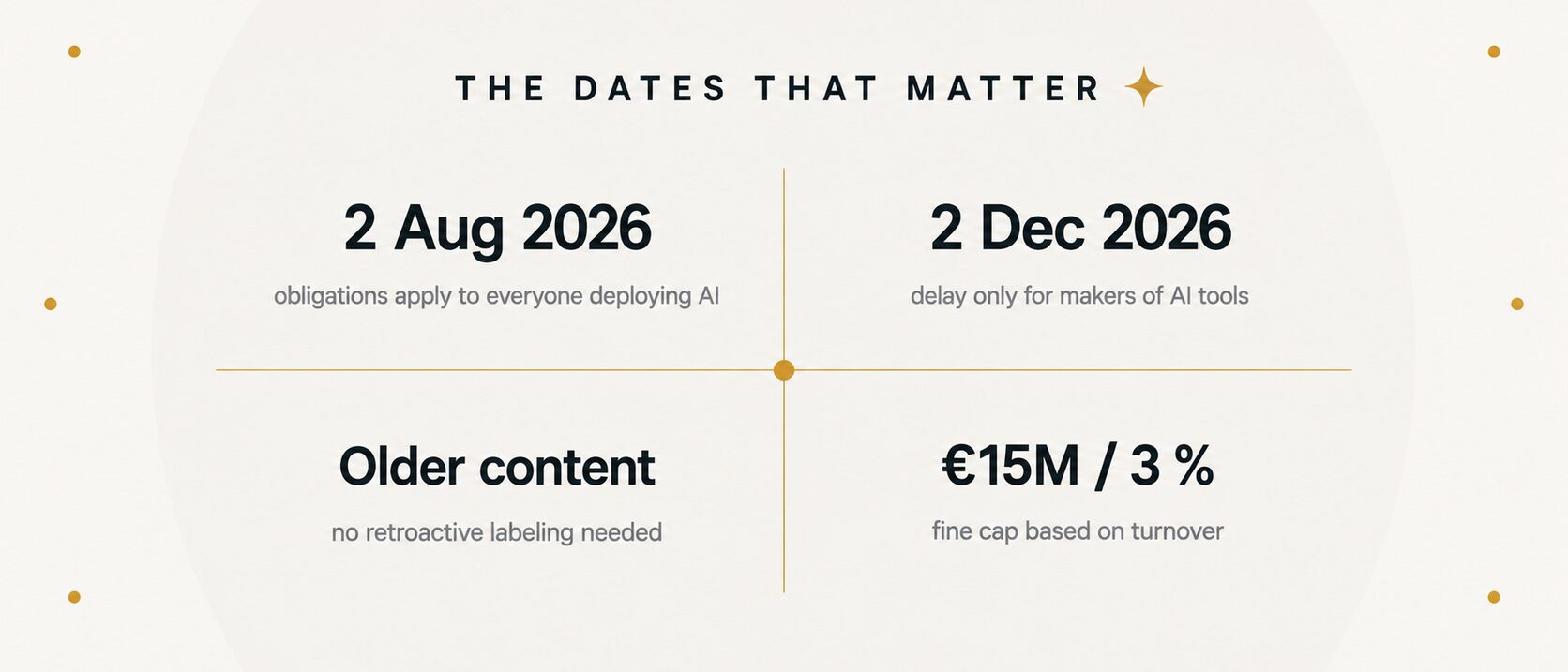
The decisive date has already passed. Article 50 has been in effect since 2 August 2026 and covers all content published from that day on. Most questions come up around the December delay, older content and the size of the fines.
The December delay only applies to the makers of AI tools
The delay until 2 December 2026 belongs only to providers of generative AI tools placed on the market before 2 August 2026, and only for machine-readable marking of outputs (metadata, watermarks). Visible labels and the chatbot introduction have to be in place from August.
Older content needs no retroactive labeling
The obligation covers content published from 2 August 2026. For older content the Commission recommends voluntary labeling but does not require it.
How the fine is calculated
The cap of 15 million euros or 3 percent of worldwide turnover applies as whichever is higher. For small and medium-sized companies the lower of the two limits applies instead. Authorities weigh the severity and duration of the infringement and the level of cooperation.
A small company with a 10 million euro turnover therefore faces a cap of 300 thousand euros, that is 3 percent of turnover. A large company with a 100 million euro turnover faces the full 15 million euros, because for it the higher limit applies. A multinational group with a billion euro turnover can face up to 30 million euros.
The quality of the label matters too
Regulators will assess not just whether a label exists, but whether it is clear, distinguishable and accessible. In other words, whether the user actually notices it.
How to prepare
-
Map the AI in your company
Chatbots, visuals, videos, voice recordings, text. Find out which of it customers see.
-
Sort the content into two groups
The first is realistic AI content, such as a virtual model or a cloned voice, that reads as a genuine record and needs a label. The second is interaction with AI, meaning a chatbot that has to introduce itself in its first message.
-
Set up consistent labeling
Label wording, icons, placement. With larger content volumes it pays to build labeling straight into the admin. When uploading content, the editor marks whether it is AI content and the system adds the label and metadata automatically.
-
Check new content from 2 August 2026
Everything realistic and AI-made that you publish from that date must already be labeled.
Sources and supervision
The regulation was adopted by the European Parliament and the Council of the EU back in 2024, and Article 50 became applicable on 2 August 2026. On 20 July 2026 the European Commission adopted official guidelines for it, and there is also a voluntary Code of Practice on Transparency of AI-generated Content, including uniform labeling icons. The text of Article 50 itself is on the European Commission’s AI Act Service Desk.
Enforcement falls to national market surveillance authorities in each member state. In Slovakia it sits with the Ministry of Investments, Regional Development and Informatisation, in Czechia with the Czech Telecommunication Office.
At Vyxos we’ll help you map the AI in use in your company, assess which content actually requires a label, and build automated labeling straight into your admin. Every new image, video or chatbot then complies with the AI Act without extra manual work. Get in touch and we’ll prepare a concrete plan.